
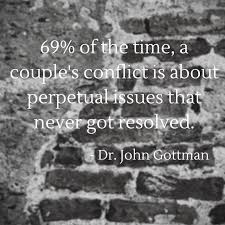
I believe that the difference between how happily and unhappily married couples address perpetual problems comes down to their willingness to compromise and accept the fact that there are going to be differences in their marriage. Research has shown that 69% of relationship conflict is about perpetual problems. Gottman (2015) states that perpetual means “They will be a part of your lives forever in some form or another” (p.137). I learned this first hand when I got married to my husband almost 12 years ago.
Here’s a little background of our backgrounds. I come from a big family, I have ten brothers and sisters. We all have a feisty streak in us. If we don’t like something or if something is bothering us, we speak up and say something. We express our feelings freely. My husband also comes from a big family. He has seven brothers and sisters. He comes from a household that doesn’t talk much about their feelings. People don’t talk about disagreements or if things bother them.
Our first couple of years of marriage were a big adjustment for us. I wanted him to express his feelings and thoughts on things and he had a hard time doing that. He wanted me to “relax” a little and brush stuff off, and I had a hard time doing that. I’m not sure why it took us so long to figure out but eventually something clicked and we realized that we were both raised with different communication styles. Once we realized that we were able to better understand each other. We came to realize that it’s okay for us to express ourselves if we are respectful of one another. We have since tried to incorporate each our family’s communication styles into our marriage and it has been working great. We both compromised and realized that somethings are minor compared to the whole scheme of things.

An example of an unhappily married couple addressing perpetual problems would be our dear friends. They have been married for six years and during the entire six years have argued relentlessly about house hold work. He thinks she should be doing most of the work because he works longer hours than she does. She thinks that he should help more because she works and takes care of their toddler. They are both very stubborn and will fight “tooth and nail” to be right. Eventually they both say they will try and help each other out more often, but lack action afterwards. With each argument you can see the respect they have for each other diminish and the gap between them gets a little bigger. I worry for my friend’s marriage and see more negativity between them than I do love.
 Strong Marriages Leads To Strong Families