Money Management

In her book Till Death Do Us Part Dr. Bernard Poduska talks about family rules that can regulate our perceptions and behaviors in most areas of a person’s family life. These areas include how a person tends to manage money.  I found this part of her book very interesting.  I looked back at my own upbringing and life experiences and found this to be very true.  There were areas I didn’t even realized had affected me from my childhood, that in turn really did. I am now married with children of my own and I find myself doing things that my parents did when it comes to money matters.
moneysuccess

Family rules are passed down across three levels: explicit, implicit, and intuitive. Poduska (2000) states, “Explicit family rules are expressed verbally” (p.26). An example of this for me growing up was my parents always told us kids that it was important to live within our means.  They also would say, “don’t buy something if you don’t have cash to pay for it.”  Today, I feel strongly about the wise financial advice I learned at a young age from my parents . My husband and I don’t care about the “latest and greatest” phones, cars, or clothing styles. We know what is important to us. We feel if you get caught up in the fads it can cause a lot of financial struggles. Implicit rules are those taught through nonverbal communication.  Poduska (2000) states, “Implicit family rules often have the greatest impact on our lives” (p.27). My mother led and taught us my example.  She shopped sales and used coupons.  It was through her example that I learned how far I could stretch a dollar.  My husband is often amazed at my shopping abilities and how much I save our family. Intuitive rules are also unspoken, but these rules are based on family heritage. In our family we believe that no one should get left behind and if you borrow money from someone, you pay them back promptly.  I haven’t been on this end as an adult, but as a teenager I have.

dont-go-broke-trying-to-look-rich-act-your-wage-quote-1


I have learned that ultimately, we are responsible for how successful we are in financial matters. You don’t have to be rich to have a good life.  There are plenty of people who make great money, but are not financially smart with that money. If we learn to live within our means and not on credit, we will be just fine. My husband and I have taken those financial experiences we grew up with, and applied those we found helpful in our own marriage. The important thing is to discuss the topic of money  before you get married and to make sure both people are on the same page.
spendinghabits

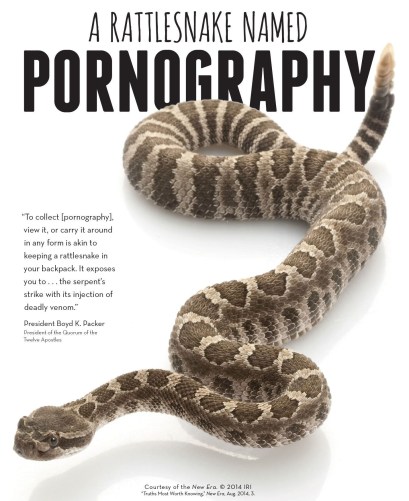
Pornography

We live in a digital world full of indecent imagines and inappropriate texts. Pornography is growing at rates that are hard to keep up with.  We have been warned of the damaging effects of pornography  has on individuals and on marriages. Statistics from, familysafemedia.com and several different reputable sources including Google, Word Tracker, PBS, MSNBC, NRC, and Alexa show that:

• The worldwide pornography industry generates revenues of around $ 56 billion, of which $12 billion is in the US. Child pornography generates about $3 billion annually.

• There are around 4.2 million pornography websites (12% of total websites) offering about 372 million pages. About 100,000 sites offer child pornography.

• There are around 68 million requests to search engines daily for pornographic content (25% of total search engine requests).

• There are about 1.5 billion pornographic downloads each month (35% of all downloads).

In my marriage, there are things I can do to help protect myself and my spouse from the damaging influence of pornography.  I can make sure that my husband and I set boundaries on our use of electronics. Just as we set limits on our children’s use of technology use, we too can do the same for ourselves. I am reminded of a conference we had with the youth in our ward about the dangers of technology.  Our bishop gave the youth some great tips and safeguards for the youth follow. I think those tips and safeguards can be applied in my own marriage.


We need to keep an open line of communication with one another.  It’s important to check in on each other.  I personally will ask my husband randomly if there is anything we wants to talk about or if there are things he has seen or has been looking at and he does the same with me.  It isn’t awkward or weird for us because we both know the importance of just checking in.  Our bishop in our singles ward suggested that it’s a good thing for couples to do and we decided to follow that counsel.

rattlesnake

In our home the computer is in a common place that is open to the rest of the house.  Having the computer in a central area helps prevent any type of temptation for looking up inappropriate media. Knowing that at any moment someone could walk by doesn’t allow for much secrecy.

I think the most important thing my husband and I can do is to make sure that we are sticking to the covenants we made in the Holy Temple nearly 12 years ago.  We can set up spiritual safeguards by having family prayer, individual prayers, and prayers as a couple.  By reading from the scriptures we learn from those of old. If we are doing our best to live a life as Christ lived there isn’t room for the evils of pornography and the trail of despair it leaves behind.

Nurture and Admiration

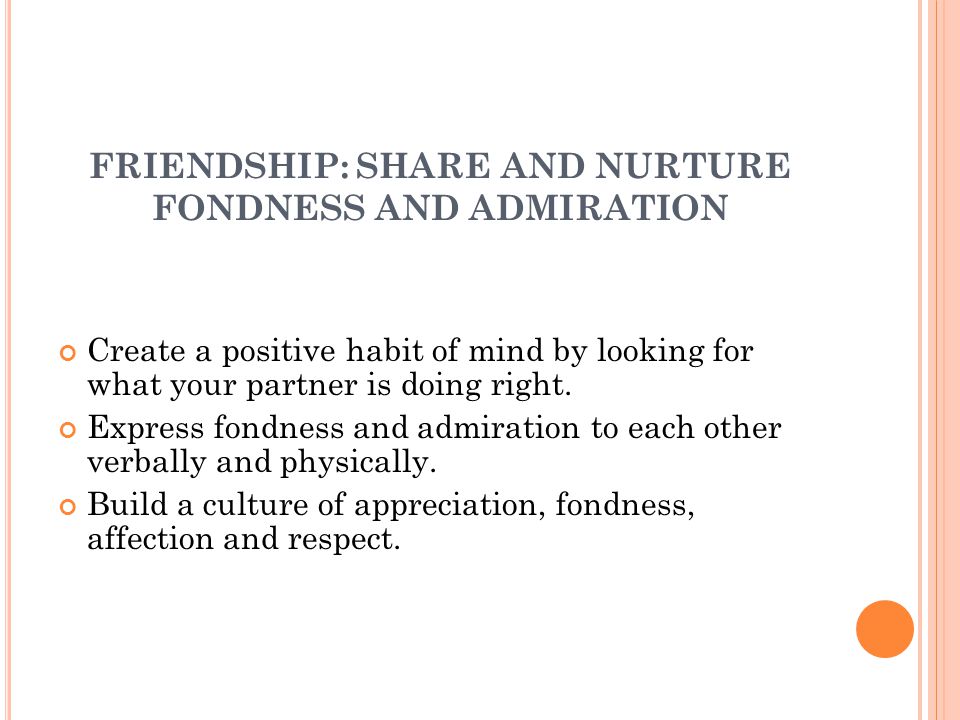
The most important thing I learned from Gottman’s book is the importance of nurturing your fondness and admiration for your spouse. It seems like such an easy thing to do but as time has gone on in my marriage or when changes have happened, I have slacked off a little.  It’s not that I have forgotten, it’s just that now, I have children to take care of, school work, kid’s activities, church responsibilities and so much more. The early years of our marriage was just the two of us.  It was much easier to focus on each other before kids came.  I assume sometimes that my husband knows how much I love and appreciate all that he does for me.  I have realized that by reading Gottman’s book, The Seven Principles for Making Marriage Work, I need to take more time to express and verbalize the admiration I have for him. Gottman (2015) states, “Fondness and admiration are two of the most crucial elements in a rewarding and long-lasting romance” (p.69).

ALL Header - May 2018 (1)

I have enjoyed reading and learning more on this topic. Gottman (2015) states., “If a couple still have a functioning fondness and admiration system, their marriage is salvageable” (p.68).  That says a lot about how we need to do are part to make sure are marriage is being taken care of.  Gottman (2015) states, “Fondness and admiration are antidotes for contempt” (p.71). I learned that if I on focus on all the good things my husband does for me, it is harder to be angry with him when he does something might bother me.    Showing appreciation goes a long way.  This principles caused me to reflect on my own marriage and I’ve realized that I need to do better and expressing my thanks for all of the big and small things my husband does not only for me but for our family also.

slide_17

Perpetual Problems

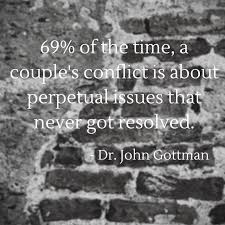
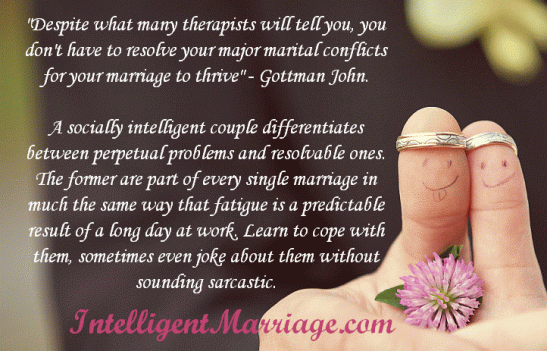
I believe that the difference between how happily and unhappily married couples address perpetual problems comes down to their willingness to compromise and accept the fact that there are going to be differences in their marriage. Research has shown that 69% of relationship conflict is about perpetual problems.   Gottman (2015) states that perpetual means “They will be a part of your lives forever in some form or another” (p.137). I learned this first hand when I got married to my husband almost 12 years ago.

pproblems

Here’s a little background of our backgrounds.  I come from a big family, I have ten brothers and sisters.  We all have a feisty streak in us.  If we don’t like something or if something is bothering us, we speak up and say something.  We express our feelings freely.  My husband also comes from a big family.  He has seven brothers and sisters.  He comes from a household that doesn’t talk much about their feelings.  People don’t talk about disagreements or if things bother them.

Our first couple of years of marriage were a big adjustment for us.  I wanted him to express his feelings and thoughts on things and he had a hard time doing that. He wanted me to “relax” a little and brush stuff off, and I had a hard time doing that.  I’m not sure why it took us so long to figure out but eventually something clicked and we realized that we were both raised with different communication styles. Once we realized that we were able to better understand each other.  We came to realize that it’s okay for us to express ourselves if we are respectful of one another.  We have since tried to incorporate each our family’s communication styles into our marriage and it has been working great. We both compromised and realized that somethings are minor compared to the whole scheme of things.

gottman perptual

An example of an unhappily married couple addressing perpetual problems would be our dear friends.  They have been married for six years and during the entire six years have argued relentlessly about house hold work.  He thinks she should be doing most of the work because he works longer hours than she does.  She thinks that he should help more because she works and takes care of their toddler.  They are both very stubborn and will fight “tooth and nail” to be right.  Eventually they both say they will try and help each other out more often, but lack action afterwards. With each argument you can see the respect they have for each other diminish and the gap between them gets a little bigger. I worry for my friend’s marriage and see more negativity between them than I do love.

Pride

I have been married for twelve wonderful years and during that time I have learned a lot about how pride effects marriages. I would love to sit back and say that things were all roses for us when we first got married.  In fact, most of the time it was just that roses. There was one thing that would pop in and out of our marriage that made things quite difficult sometimes. That thing is known as pride. I learned the good and bad about myself during those first few years. I had a hard time admitting this in the beginning of our marriage but I’ll say it now, I was prideful in some areas.

I loved President Benson talk titled Beware of Pride. President Benson (1989) states, “The central feature of pride is enmity-enmity toward God and enmity toward our fellowmen. Enmity means hatred toward, hostility to, or a state of opposition” (p.2). I didn’t have the hatred part of it, but I did have some hostility.  I had a hard time seeing my faults and would get bothered with my husband when we try to help me acknowledge them.  I would try to twist things around and take the blame off of me.  Another great quote by President Benson(1989)states, “ Pride is a sin that can readily be seen in others but is rarely admitted in ourselves”(p.2). The opposition really came into play when it finally hit me that maybe I was partly to blame.  I pushed back for a while before I finally let go of that pride.

Pride

As my husband and I learned to let go of our pride, our marriage began to thrive. We learned from one another strengths and weaknesses. We began to value more of one another’s thoughts and opinions. We mattered to each other, but most importantly we loved and respect not only each other but our marriage. We turned towards our Heavenly Father for strength and guidance. We learned to look at each other as human beings with feelings, not just an object.  Marriage for us only gets better and better each year.

Shared Meaning

Before my husband and I got engaged, I received some of the best advice a person could get before getting married. My older sister sat me down and said, “Summer make sure that you talk to this man that you love about the important things in your life before getting married.  Talk about how you want to parent, how many kids you want, your hopes and desires, your thoughts on your role as a wife and then let him do the same.”  I did just as my sister suggested and talked to my fiancé. We asked some hard questions and we asked the ones we might not have thought about talking about until maybe an issue arose.

578a40ae4bfaf924b5675453a87ff77a

At the time I didn’t realize just how good that advice was that my sister have given me.  As a couple that was about to get married we were able to see how we connected on our thoughts, dreams, roles, and expectations of one another.  Gottman (2015) stated, “I’ve come to identify four critical mainstays of shared meaning.  When couples build these together, they enrich their relationship and family life” (p.263).  Discussing these topics before marriage let us see how compatible we really were.  In the beginning stages of a relationship its easy to just see the good in each other, it is easy to look pass those little things that might cause issues down the road. We had such a positive experience of doing this, that we now suggest the same thing to those we know that are getting married.

Twelve years later my husband and I still make sure to feed our marriage by taking care of what Gottman (2015) calls the “Four Pillars of Shared Meaning-rituals of connection, support for each other’s roles, shared goals, and shared values and symbols.”  We have established traditions in our family that we look forward to. Traditions like having a fancy valentines dinner at home, making Mexican food on Christmas eve with my family, and dressing up as a family on Halloween.  Some of these traditions are new and some have been passed down from our grandparents. We have learned to continue to support one another in our roles as a spouse, parent, and friend.  We try our best to encourage each other to pursue their dreams.  We spend time together doing things we love as a couple and a family.  Sure, we might not agree on everything, but doing as my sister advised us to do years ago help us to hash out or talk about some of the big areas of disagreements.

Gottman, J. M., & Silver, N. (2015). The seven principles for making marriage work. New York: Harmony Books.

Love Map

This week had me reflecting on how my husband and I spent our time together before we got married.  We dated a lot and made many great memories along our way.  We were eager to get to know each other on a deeper level than just “friends.”  I wanted to know everything about my husband and he wanted to know everything about me.  We both genuinely had that desire to know those small details that made us who we both were. This was the beginning of our “love map.” In his book The Seven Principles for Making Marriage Work, Gottman (2015) states, “… a richly detailed love map-my term for that part of your brain where you store all the relevant information about your partner’s life” (p. 54). This map gave us a strong foundation to build our relationship.

Love Map

When my husband and I got married our “love map” kept growing with each new experience we faced as individuals and as a couple.  A few years into marriage we started our family and boy did that change things up with our mapping skills. We had a few adjustments we had to learn to deal with once we had kids. Our biggest thing is time.  It was a lot easier for us in those beginning years of marriage to set time aside to go on dates and spend time together without interruptions.  I have noticed that if I/we plan something in advance and put it on our calendar than it happens. I strongly believe that the love map we had been creating all these years protected our marriage as we made those major adjustments.  We had a deep understand of each other’s wants, desires, fears, and struggles. How grateful I am that we took the time start our love map early on.  I know that it has blessed our marriage and our family.  I look forward to continuing adding more details throughout our marriage.

great-marriages-are-built

Gottman, J. M., & Silver, N. (2015). The seven principles for making marriage work. New York: Harmony Books.

The Importance of Friendship in A Marriage

In reading about the Gottman’s research, we learn that that strong marriages have strong friendships as one of their defining characteristics. In fact, Gottman (2015) states, “At the heart of the Seven Principles approach is the simple truth that happy marriages are based on a deep friendship.” (p.21). There are many reason’s why keeping that friendship going makes for a healthy marriage.

I think of my best friend growing up.  The two of us were inseparable, we did everything together. If she was going through some type of heartache, my heart felt pain for her.  If I accomplished something I was working on, she felt joy and happiness for me.  We understood each other on many levels. We respected one another’s opinions and valued the others advice when given.   We genuinely enjoyed each other’s company. Sure, we hit some rough patches, but our friendship was more important to us than those disagreements.

marriage and friendship quote

Deciding to marry someone doesn’t just happen overnight. I think all successful marriages start off as friendships.   I met my husband when I was 16 and we started out just as friends.  We enjoyed the same type of activities, had similar humor, and just got each other. Three years later that friendship had progressed.  He would go out of his way to do sweet little things for me because he knew I loved that.  I found myself naturally wanted to just be better around him.  I felt like we brought out the best in each other. It wasn’t just about physical attraction, it was much deeper than that.  It was those little tender moments we shared together, it was the laughs we had, it was the longing to see each other again, and it was that man cheering me one even when I fumbled. Though, it is a different relationship than the one I had with my best friend, they share many similarities.

If I take the time to nurture the “friendship” in my marriage, I know when trials come it will be easier to brush them off. Gottman (2015) said it best, “Friendship fuels the flames of romance because it offers the best protection against feeling adversarial toward your spouse.” (p.22). I think that if more people realized just how important friendship is in a marriage, we would see a lot less divorce and happier marriages.

Covenant Marriage

This week I learned more about covenant marriages. I tried to think about my own marriage as I read different talks on this topic.  One talk I loved was given by Elder Bruce Hafen (1996) titled, Covenant Marriage.  I strongly recommend his talk to anyone considering marriage or is currently married. I was sealed to my husband for time and all eternity in the San Diego temple nearly twelve years ago.  I remember that day very vividly and had that same happiness on my face that was mentioned in his talk.  I thought, “Our marriage is going to be perfect!”  That was the young newlywed girl thinking.

newlywed_marriage-427x240

Our marriage was going great, but as we started to adjust to our new lives together as a married couple, we hit a few bumps along our way.  We soon realized the difference between having a covenant marriage verses a contract marriage. Hafen (1996) said it best,” When troubles come to a covenant marriage, the husband and wife work them through… Contract companions each give 50 percent; covenant companions each give 100 percent” (p.1). We could have easily given up on our marriage over petty disagreements; we had friends that did just that.  We loved each other though and we made a covenant not only to each other, but most importantly our Savior. We knew that those things could be fixed and they were minor in the big scheme of things. We chose to address any issues we were having and committed to work on them. Our marriage was too important to us to let minor things get in our way.

wolf_pack

Hafen (1996) suggests that there are three kinds of wolves that test every marriage. The first is natural adversity, the second is one’s own imperfections, and the third is excessive individualism. An example of a natural adversity that happened early on in our marriage was having a new born baby with many medical needs.  It was a scary time of uncertainties and we very easily could have gone down that deep dark hole. In fact, I was told by many medical professionals that the divorce rates are extremely high when parents have a child with special needs. My husband I decided that we were not going to be a statistic and we turned for our Heavenly Father for strength and comfort.  I am so glad we supported each other during that time because our daughter brings unmeasurable joy into our family. There were times where I found it hard trying to juggle all my responsibilities and felt I was not doing my job as a young wife and mother. That mean wolf tried hard, but my husband was great at reassuring me that I was doing a great job. I could have allowed my own imperfections tear apart my marriage, but again, I going to let that happen. Those early years of marriage were learning years for us.  We learned that we needed each other and nothing was going to happen if we didn’t work as a team. Excessive individualism wasn’t so hard for us because we learned early on the need to help one another.I look back and see how many times those “wolves” tried to creep into our marriage and I know they will continue to do so if I/we allow them to.

I am grateful for my covenant marriage to my eternal companion. A covenant marriage means even with trials, we will still fight for those sacred covenants we made kneeling at that alter in San Diego nearly twelve years ago.  We can realize the strength we possess and know that we are not alone in our marriage.  We have each other to lean on for support and the best compass to guide and direct us, our Lord and Savior.

Hafen, B. C. (n.d.). Covenant Marriage. Retrieved from https://www.lds.org/general-               conference/1996/10/covenant-marriage?lang=eng

Court Ruling on Same-Sex Marriage

The supreme court of the United States made history on June 26th, 2015.   Same -sex partners from various states and their lawyers argued that the same-sex marriages should be recognized in all states and that they should reap the same benefits as married couples.  They argued that under the Due Process Clause of the Fourteenth Amendment, no State shall “deprive any person of life, liberty, or property, without due process of law.” Justices Roberts, Scalia, and Thomas disagreed with redefining the definition of marriage but ultimately the majority felt otherwise and on June 26th 2015 the definition of marriage changed.

Justice Roberts (2015) had this to say regarding the court’s decision:

If you are among the many Americans—of whatever sexual orientation—who favor expanding same-sex marriage, by all means celebrate today’s decision. Celebrate the achievement of a desired goal. Celebrate the opportunity for a new expression of commitment to a partner. Celebrate the availability of new benefits. But do not celebrate the Constitution. It had nothing to do with it. I respectfully dissent. (p. 68).

There was a major theme with all the dissenting justices, that theme was that marriage should be up to the states to decide, not the federal government. I agree with Justice Roberts that the constitution did in fact have nothing to do with their win.  There should be order in all things, just as there is order in our church.

Justice Thomas (2015) had this to say:

Our Constitution—like the Declaration of Independence before it—was predicated on a simple truth: One’s liberty, not to mention one’s dignity, was something to be shielded from—not provided by—the State. Today’s decision casts that truth aside. In its haste to reach a desired result, the majority misapplies a clause focused on “due process” to afford substantive rights, disregards the most plausible 18 OBERGEFELL v. HODGES THOMAS, J., dissenting understanding of the “liberty” protected by that clause, and distorts the principles on which this Nation was founded. (p. 94).

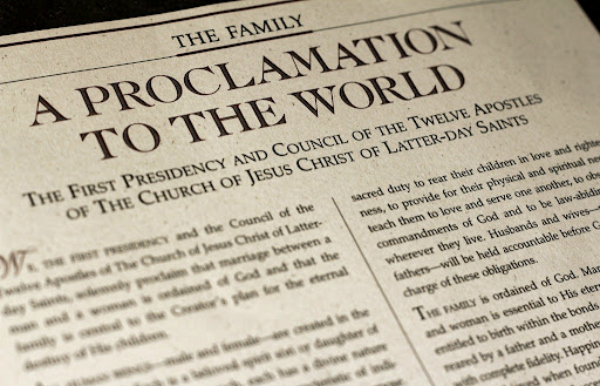
I know there are same-sex couples that are great people, in fact I have a few family members who are.  We can still love them and follow Christ’s example of pure love but not change our fundamental beliefs.  Christ taught us to love our neighbors, comfort those in need of comfort, not to judge, and so much more.  Reading about the couples I felt that they were good people, but that doesn’t change the fact that marriage should be changed. We know that the gospel of Jesus Christ teaches that marriage is ordain of God between husband and wife. We learn about the importance the role of a family plays in the great plan of happiness.

I feel that God way is straight forward. What is wrong is wrong and what is right is right.  There isn’t mixing the light with the darkness.  If we stick to the teachings of Jesus Christ found in the scriptures and our latter-day prophet all will be well. Standing up for marriage in world that devalues the sacred unity can be hard but God is always there to lend a helping hand. A true disciple of Christ is not a part-time gig.

fam-proc